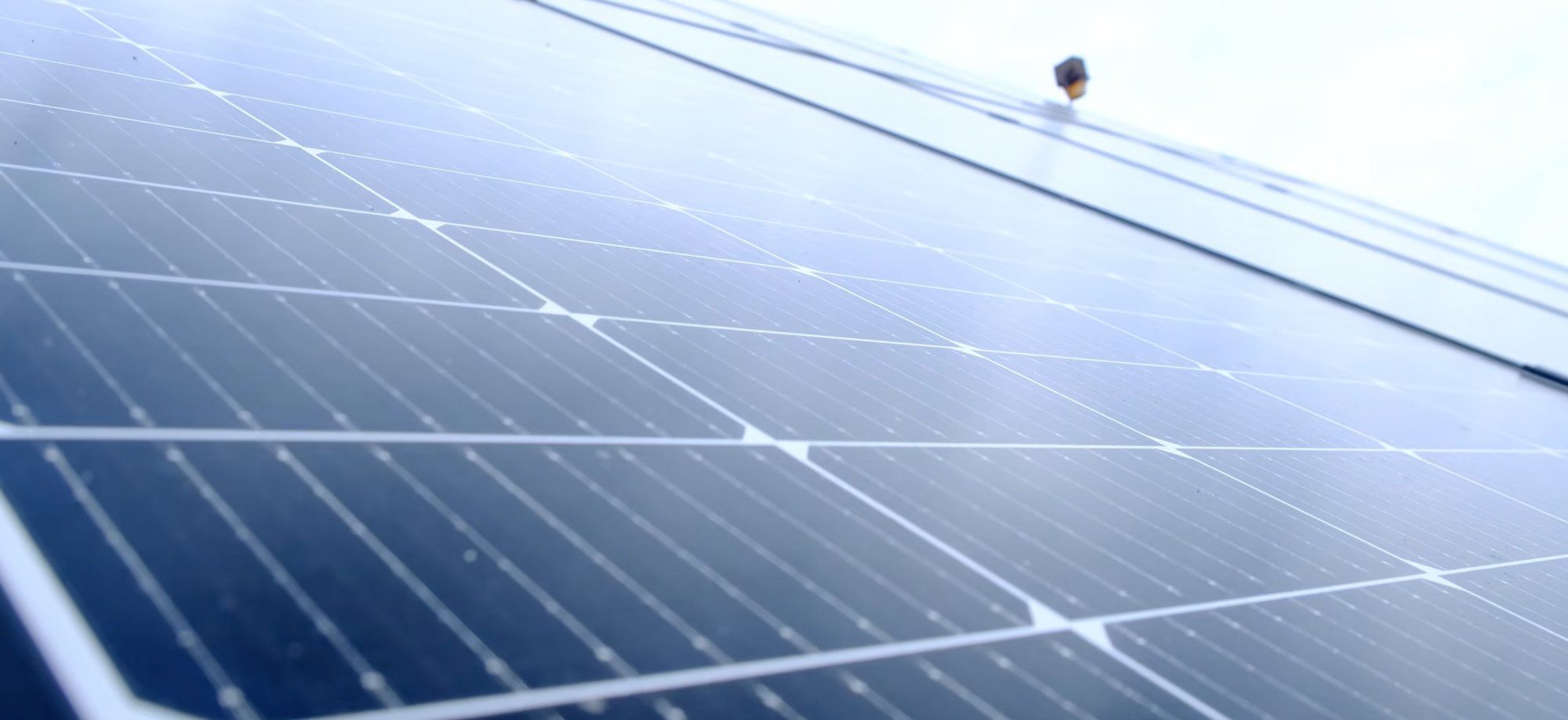
Solar panel cleaning
Solar panel cleaning restores the output that dust, soot, pollen, leaves and bird droppings take away over time. At industrial plants and logistics centres, panels get dirty faster than on houses: dust from yards, lorry exhaust and production emissions settle on the glass every day, and on flat factory and warehouse roofs the rain does not wash the dirt off the bottom edge of the modules. We clean solar panels. We serve plants and warehouses in the Greater Poland, Lubusz and Lower Silesian voivodeships.
At a glance
- We serve plants and warehouses in the Greater Poland, Lubusz and Lower Silesian voivodeships.
- We work 365 days a year, around the clock.
- We hold public liability insurance of PLN 1 million with Allianz, per occurrence and in the aggregate.
- We clean solar panels.
- We clean installations on the roofs of industrial and warehouse buildings, ground-mounted installations at plants and solar farms.
- Example job: a warehouse roof, 1,200 panels (approx. 500 kWp) — 2 working days, 3 people, a MEWP.
Who it is for
- Production plants with solar installations on their factory roofs.
- Logistics centres and warehouses with large, flat roofs covered in panels.
- Owners of solar farms and of ground-mounted installations at plants.
- Sites close to sources of dust — roads, manoeuvring yards, aggregate quarries, farmland.
- Industrial park managers who look after installations for several tenants.
How much energy a dirty panel costs you
Dirt on a panel acts like shade: it blocks some of the light before it reaches the cell. An even layer of dust cuts output by a few per cent, and where there is heavy dust — near roads, yards, aggregate quarries or farmland — the loss rises to over ten per cent. On an installation of several hundred kilowatts, that is real money every month.
Spot soiling is more dangerous than an even layer of dust. Bird droppings or a stuck leaf shade individual cells, and a shaded cell in a string can overheat. These hot spots speed up module ageing and reduce the output of the whole string.
On factory and warehouse roofs, panels are usually mounted at a shallow angle. Rain then washes off only the loose dust, while the dirt runs down to the bottom edge of the frame and dries there, forming a band that rainwater can no longer remove.
| Soiling | Where it comes from | Effect |
|---|---|---|
| Mineral dust | Yards and manoeuvring areas, access roads, earthworks, fields | An even drop in output |
| Soot and greasy deposits | Lorry exhaust, production emissions, chimneys | A sticky layer that rain does not wash off |
| Bird droppings | Birds on factory roofs and structures | Shading and overheating of individual cells |
| Pollen, leaves, moss | Trees and greenery near the installation | Deposits along the bottom edge of the frame and, over time, biological growth |
| Streaks and limescale | Rainwater and washing with hard water | Dull patches on the glass |
How to clean panels safely
Panel glass has an anti-reflective coating that scratches easily. A pressure washer can damage the seals and the frame, a rough brush or an abrasive can damage the coating, and an aggressive detergent leaves a film that attracts dirt even faster. The panel manufacturer usually sets out the permitted cleaning methods in the manual, and ignoring them can cost you the warranty.
A safe method rests on three things: soft bristles, a small amount of cleaning agent and water that leaves no residue when it dries. Cleaning in the morning or early evening protects glass heated by the sun from thermal shock caused by cold water.
- Deionised water — it leaves no streaks or limescale on the glass.
- Soft-bristle brushes on water-fed poles instead of a pressure washer.
- No aggressive chemicals or abrasives — for heavy soiling, only products approved by the module manufacturer.
- Cleaning in the morning or early evening, when the panels are not hot.
- A visual check while cleaning — cracked glass, damaged cables, loose fixings.
- We clean panels with deionised water, which leaves no streaks or limescale deposits on the glass.
- We work with soft-bristle brushes on water-fed poles, without aggressive chemicals and without pressure washers, which can damage the glass coating and the module seals.
Working on a factory roof and on a solar farm
An installation on a factory or warehouse roof means work at height, often on a roof of sandwich panels or profiled metal sheeting. Before going up, you need to know the roof’s load capacity and the designated walkways, and you need anchor points for safety lines and protected rooflights — a fall through a rooflight is one of the most common accidents during work on industrial roofs.
A ground-mounted solar farm is safer but has other challenges: long rows of modules, access for equipment between the rows, and grass that has to be mown so that it does not shade the lower panels. Cleaning there is therefore often combined with grounds maintenance around the installation.
How often should panels be cleaned? Usually once or twice a year — in spring, after the pollen season, and in autumn, after the leaves have fallen. Installations close to roads, yards, livestock farms and plants that emit dust need cleaning more often. The simplest sign is a drop in output in the inverter monitoring under similar sunlight.
- Employees who work at height have up-to-date medical certificates for work above 3 m.
- We have employees qualified for rope access (IRATA or OTDL, the Polish rope access association).
- Our operators hold UDT category IP licences (UDT: Poland’s Office of Technical Inspection) for boom lifts and scissor lifts.
- On roofs we work with fall protection, and we use a MEWP (mobile elevating work platform) to reach high installations.
Checklist: what to ask a contractor
Questions worth asking any cleaning company before you sign a contract, whoever you choose.
- What does the contractor clean the panels with — what water, what brushes, does it use chemicals?
- Does the method follow the module manufacturer’s instructions and leave the warranty intact?
- How does the contractor make roof work safe — anchor points, rooflights, qualifications?
- After cleaning, will you be told about any damage to the modules that was spotted?
- What is the contractor’s public liability insurance cover?
From our work
Does SARA SYSTEM clean solar panels?
Yes. We clean solar panels. We serve plants and warehouses in the Greater Poland, Lubusz and Lower Silesian voivodeships.
How often should solar panels be cleaned?
Usually once or twice a year — in spring, after the pollen season, and in autumn, after the leaves have fallen. Installations close to roads, manoeuvring yards and plants that emit dust are cleaned more often. The sign to look for is a drop in output in the inverter monitoring under similar sunlight.
Isn’t rain enough?
Not always. Rain washes off loose dust, but it does not remove greasy soot, bird droppings or the deposit along the bottom edge of the frame — especially at the shallow tilt typical of installations on factory and warehouse roofs.
What do you clean the panels with?
Deionised water and soft-bristle brushes, without aggressive chemicals and without pressure washers, which can damage the glass coating and the module seals.
Can cleaning damage the panels or void the warranty?
It can, if they are cleaned with a pressure washer, an abrasive or an aggressive detergent. That is why the method is matched to the module manufacturer’s instructions: soft bristles, water that leaves no residue, and cleaning outside the hours of strongest sunshine.
What public liability insurance does SARA SYSTEM have?
We hold public liability insurance of PLN 1 million with Allianz, per occurrence and in the aggregate.
Often ordered together
Integrated cleaning services
Contract cleaning of plants and logistics centres: buildings, offices, grounds, consumables. Two contract managers per client, 92% of revenue from long-term contracts.
Details Grounds and car parksGrounds maintenance
Sweeping of yards and car parks, grass cutting, flail mulching of rough ground and ditches at plants and warehouses. 167,000 m² of green areas under contract.
Details Grounds and car parksGritting and snow clearance
Seasonal snow clearance and gritting of access roads, yards, loading bays and car parks in industrial zones. A tractor on standby for a fixed monthly fee.
Details Technical services and maintenanceBuilding maintenance
Upkeep and minor repairs in production buildings, offices and across the site, plus preparation for periodic inspections. Staff with electrical qualifications.
DetailsIndustries
Automotive
Factory cleaning, press and paint line cleaning and floor deep cleaning in automotive plants, around production, shutdowns and IATF 16949 audits.
Logistics and warehousing
Warehouse cleaning, removal of forklift tyre marks, cardboard and film segregation, and snow clearance of access roads at logistics centres and warehouses.
Ask AI about your site
The AI assistant will read this page and the calculator, ask you about the scope you need (“Solar panel cleaning”) and then, one question at a time, about your site — floor area, floor type, shifts, waste and site requirements. Finally, it will prepare a ready-to-send request for quotation with a list of open points.
- ChatGPT opens with a ready-made prompt (new tab)
- Claude opens with a ready-made prompt (new tab)
- Perplexity opens with a ready-made prompt (new tab)
Show the prompt
Help me prepare a request for quotation for industrial cleaning — topic: Solar panel cleaning.

First open and read these pages of the contractor SARA SYSTEM. Open them directly; do not rely on search results alone:
- https://www.sarasystem.pl/en/services/solar-panel-cleaning/
- https://www.sarasystem.pl/en/cost-calculator/
- https://www.sarasystem.pl/llms.txt

Then interview me briefly about my site. Ask one question at a time, in English, and wait for my answer. Start by asking what exactly I need in terms of “Solar panel cleaning”, then ask about the type of site and its floor area. Then ask in turn about:
1. the type of site and its floor area,
2. the floor type: bare, power-floated, sealed, painted or resin-coated concrete,
3. the soiling: tyre marks, oil, dust, old coatings,
4. the height of the building and the racking,
5. the number of shifts and whether the site keeps operating while the work is done,
6. how often the work is needed,
7. the scope: machine cleaning, high-level surfaces, washrooms, loading bays,
8. waste,
9. health and safety requirements, public liability insurance and site standards,
10. who provides the machines and chemicals,
11. the start date.
If I don't know something, record it as an open question.

About SARA SYSTEM, write only what is on these pages — do not add anything. Whatever the pages do not say, add to the questions for the contractor. If the calculator gives indicative costs, quote them as an estimate together with its assumptions.

Finally, write a ready-to-send email with the request to SARA SYSTEM (biuro@sarasystem.pl): the site parameters as bullet points and a list of open questions.
The conversation takes place in the tool you choose — we have no access to it. The assistant can make mistakes, so it is worth confirming the details with us directly.
A site survey as early as the same or the next day
We will come and look at your floors and zones, then prepare a work plan with a quote.