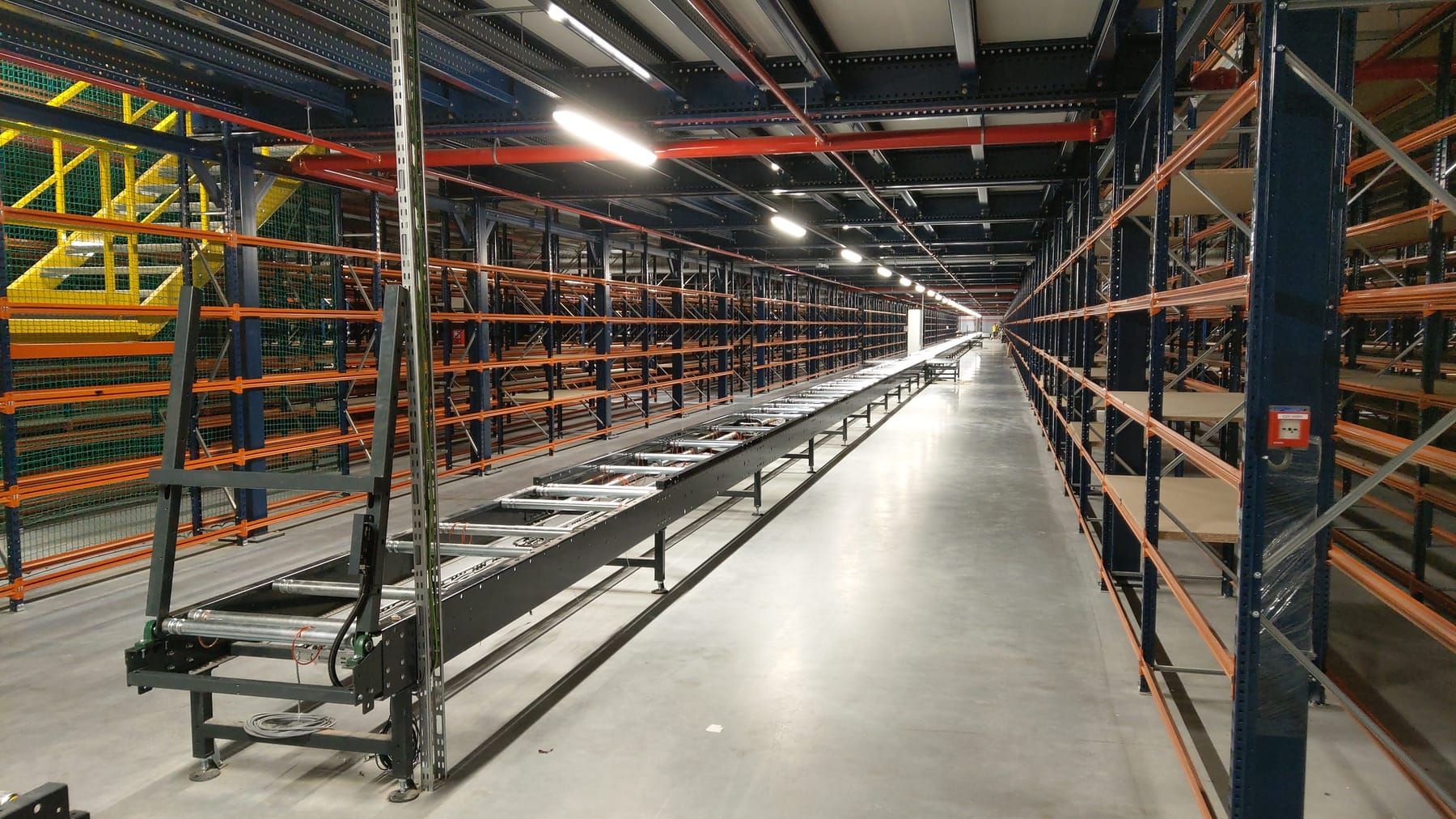
Cleaning for warehouses and logistics centres
Logistics accounts for 28% of SARA SYSTEM’s clients. We serve 33 production plants and 5 logistics centres under ongoing contracts. We look after 470,500 m² of production and warehouse space under ongoing contracts, and in 2025 we deep-cleaned 66,890 m² of floors. In a warehouse, the floor decides how clean the site is: tyre marks, dust and scraps of film under the racking affect the safety of forklift traffic and the impression the site makes on customers and auditors.
At a glance
- Of our clients, 54% are automotive plants, 28% are in logistics, 10% in the food industry and 8% in other industries.
- We serve 33 production plants and 5 logistics centres under ongoing contracts.
- We look after 470,500 m² of production and warehouse space under ongoing contracts.
- In 2025 we deep-cleaned 66,890 m² of floors.
- Deep cleaning a floor of 50,000 m² is not a problem for us.
- Companies that have trusted us include Shimano Polska, HAVI Logistics, Wirtgen Polska, Fabryka Armatur Swarzędz, Piórex, Aquaform, Kentel Polska, Hama Polska, Pago, Case-Pack, Zakłady Chemiczne Luboń, Polish Assembly Centre, Anton Röhr Logistyka, Lumel, Essel Propack and Albatros Aluminium.
- We serve plants that produce for brands such as McDonald’s, KFC, Dr. Oetker and Lindt, and in automotive for BMW and the Volkswagen Group.
The warehouse floor: tyre marks, dust and traffic safety
A warehouse floor works under constant traffic from forklift trucks and pallet trucks. Rubber from tyres, cement dust from unsealed concrete and fragments of film build up into a layer that reduces grip, lengthens braking distances and transfers dirt onto goods.
Routine machine cleaning keeps the floor in condition, but it does not remove old tyre marks or the dust that concrete gives off by itself. Deep cleaning deals with the marks, and sealing deals with the dusting — it hardens and seals the top layer of the concrete.
The narrow aisles of high-bay warehouses need a particularly even and clean floor: a very narrow aisle truck with its load raised more than ten metres reacts to every bump and every slip. There, dirt in the wheel tracks is not a question of appearance but of load stability.
Access roads, yards and loading bays: logistics starts outside the gate
A logistics centre receives and dispatches lorries around the clock, so the yard and access roads are part of the process, not just the surroundings of the building. Sand, water and packaging scraps from the yard are carried on wheels into the loading bays and on to the warehouse floor.
In winter, the same area decides whether the warehouse can operate at all. A snowed-in approach to the loading bays stops deliveries faster than a breakdown inside, which is why snow clearance of yards and access roads is planned together with cleaning, not after the first snowfall.
- We maintain external areas with 7 new Massey Ferguson compact tractors fitted with SaMASZ attachments: sweepers, gritters and snow ploughs.
- We use RCM sweepers to sweep indoor floors and yards.
Cardboard and film: waste with value
A logistics centre produces packaging waste in industrial quantities: cardboard from deliveries, stretch film from breaking down pallets, tape, void fill and damaged pallets. Most of it arises during co-packing and repacking — for example, when goods are moved from large outer cases into individual boxes.
Thrown together into a general waste container, these materials are a cost. Separated where they arise — baled cardboard and clean film — they become recyclables with real value. We segregate waste on the client’s premises. Your plant remains the waste holder; collection is handled by a waste contractor registered in BDO (Poland’s national waste database), chosen by the plant.
Segregation in a warehouse works when it is easier than throwing everything into one bin: labelled bags and bins at picking stations, a separate place for film where pallets are broken down, a baler in the goods-in area and a regular routine for moving each waste stream to the bulk containers.
Cleaning around the warehouse’s rhythm
A logistics centre often works non-stop, and the peaks — the run-up to Christmas, sales, e-commerce campaigns — shift every year. Cleaning is planned for the troughs in activity: at night, between picking waves, at weekends. We work 365 days a year, around the clock.
We serve plants and warehouses in the Greater Poland, Lubusz and Lower Silesian voivodeships. Lubusz lies where the A2 motorway meets the S3 expressway, on the border with Germany — warehouses and distribution centres are built there to serve the German market.
- In an emergency, we increase staffing on site within 24 hours.
Logistics and warehousing: our services
Floor deep cleaning
Deep cleaning of factory and warehouse floors: tyre marks, oil, ground-in dust. Greater Poland, Lubusz and Lower Silesia. In 2025 we deep-cleaned 66,890 m² of floors.
Details Industrial floorsConcrete floor sealing
Sealing and polymer coating of concrete floors in factories and warehouses: less dusting, no stains soaking in. Floor Protection Contractor Certificate, BUZIL chemicals.
Details Contract cleaningIntegrated cleaning services
Contract cleaning of plants and logistics centres: buildings, offices, grounds, consumables. Two contract managers per client, 92% of revenue from long-term contracts.
Details Contract cleaningWarehouse cleaning
Warehouse cleaning without stopping dispatch: forklift tyre marks, dust on high-bay racking, loading bays. 470,500 m² of floor space under ongoing contracts.
Details Contract cleaningWashroom consumables and chemicals
Washroom consumables in three quality tiers and BUZIL chemicals from our own warehouse, delivered to site and invoiced by usage — for plants and warehouses.
Details Specialist servicesOn-site waste management
A dedicated waste operative on your site: segregation of cardboard, plastic film, pallets and metal at source. Your plant remains the waste holder.
Details Grounds and car parksGrounds maintenance
Sweeping of yards and car parks, grass cutting, flail mulching of rough ground and ditches at plants and warehouses. 167,000 m² of green areas under contract.
Details Grounds and car parksGritting and snow clearance
Seasonal snow clearance and gritting of access roads, yards, loading bays and car parks in industrial zones. A tractor on standby for a fixed monthly fee.
DetailsDo you have experience in serving logistics centres?
Yes. We serve 33 production plants and 5 logistics centres under ongoing contracts, and logistics accounts for 28% of our clients.
How much warehouse space do you look after under ongoing contracts?
We look after 470,500 m² of production and warehouse space under ongoing contracts.
Which brands do your clients work for?
We serve plants that produce for brands such as McDonald's, KFC, Dr. Oetker and Lindt, and in automotive, for BMW and the Volkswagen Group.
Do you also sweep the yards around the warehouse?
Yes. We use RCM sweepers to sweep indoor floors and yards.
Do you serve warehouses in the Lubusz region?
We serve plants and warehouses in the Greater Poland, Lubusz and Lower Silesian voivodeships.
Ask AI about your site
The AI assistant will read this page and the calculator, ask you about the scope you need (“Cleaning for warehouses and logistics centres”) and then, one question at a time, about your site — floor area, floor type, shifts, waste and site requirements. Finally, it will prepare a ready-to-send request for quotation with a list of open points.
- ChatGPT opens with a ready-made prompt (new tab)
- Claude opens with a ready-made prompt (new tab)
- Perplexity opens with a ready-made prompt (new tab)
Show the prompt
Help me prepare a request for quotation for industrial cleaning — topic: Cleaning for warehouses and logistics centres.

First open and read these pages of the contractor SARA SYSTEM. Open them directly; do not rely on search results alone:
- https://www.sarasystem.pl/en/industries/logistics-and-warehousing/
- https://www.sarasystem.pl/en/cost-calculator/
- https://www.sarasystem.pl/llms.txt

Then interview me briefly about my site. Ask one question at a time, in English, and wait for my answer. Start by asking what exactly I need in terms of “Cleaning for warehouses and logistics centres”, then ask about the type of site and its floor area. Then ask in turn about:
1. the type of site and its floor area,
2. the floor type: bare, power-floated, sealed, painted or resin-coated concrete,
3. the soiling: tyre marks, oil, dust, old coatings,
4. the height of the building and the racking,
5. the number of shifts and whether the site keeps operating while the work is done,
6. how often the work is needed,
7. the scope: machine cleaning, high-level surfaces, washrooms, loading bays,
8. waste,
9. health and safety requirements, public liability insurance and site standards,
10. who provides the machines and chemicals,
11. the start date.
If I don't know something, record it as an open question.

About SARA SYSTEM, write only what is on these pages — do not add anything. Whatever the pages do not say, add to the questions for the contractor. If the calculator gives indicative costs, quote them as an estimate together with its assumptions.

Finally, write a ready-to-send email with the request to SARA SYSTEM (biuro@sarasystem.pl): the site parameters as bullet points and a list of open questions.
The conversation takes place in the tool you choose — we have no access to it. The assistant can make mistakes, so it is worth confirming the details with us directly.
A site survey as early as the same or the next day
We will come and look at your floors and zones, then prepare a work plan with a quote.