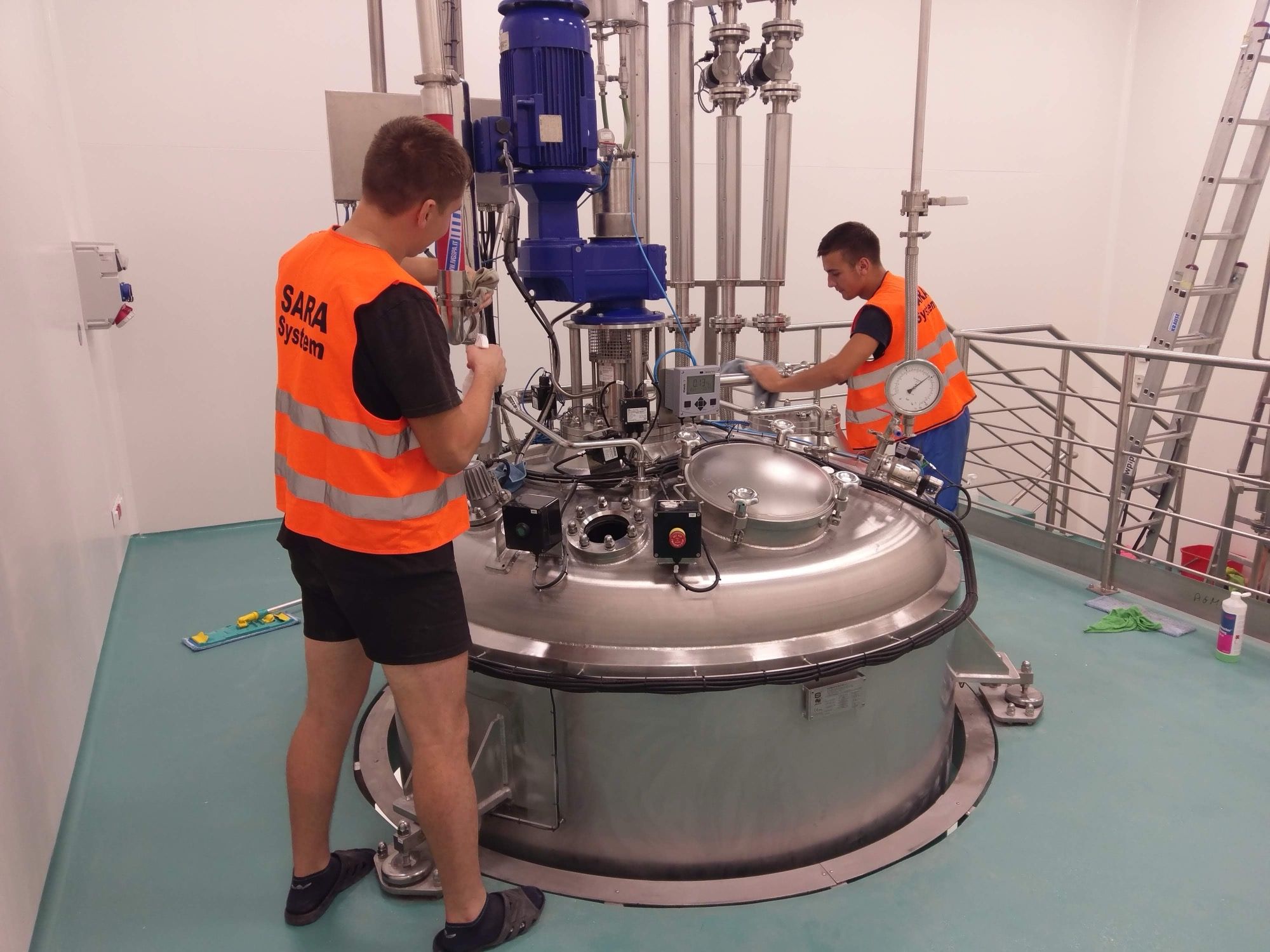
Cleaning for food plants and food packaging manufacturers
We serve plants that produce for brands such as McDonald's, KFC, Dr. Oetker and Lindt. The food industry accounts for 10% of our clients. We employ an in-house internal auditor for food safety systems, including HACCP, and we have experience in ozone treatment of rooms at food industry plants. In a plant like this, cleaning is part of the food safety system: it has its own plan, its own records and its own verification.
At a glance
- We serve plants that produce for brands such as McDonald’s, KFC, Dr. Oetker and Lindt, and in automotive for BMW and the Volkswagen Group.
- We serve plants that make packaging for international food brands.
- We employ an in-house internal auditor for food safety systems, including HACCP.
- We have experience in the ozone treatment of rooms at food industry plants.
- Of our clients, 54% are automotive plants, 28% are in logistics, 10% in the food industry and 8% in other industries.
HACCP and GMP: cleaning as part of the system
In a food plant, the HACCP system rests on prerequisite programmes — good hygiene practice (GHP) and good manufacturing practice (GMP). One of them is the cleaning and disinfection programme: what is cleaned, with what, at what concentration, how often, by whom and how effectiveness is checked.
An auditor — from the customer’s quality department, a BRCGS or IFS certification body or the State Sanitary Inspection — does not ask whether the plant is clean. They ask for the records: the signed cleaning record, the verification result and the corrective action taken when a result was poor. A cleaning contractor must therefore work to the plant’s plan and leave a trail in the documentation. A good cleaning and disinfection programme sets out:
- Scope: the rooms, machines and surfaces covered by the plan — broken down by zone.
- Method and product: product name, concentration, temperature, contact time.
- Frequency: after each shift, daily, weekly, at product changeover.
- Responsibility: who does the cleaning, who checks it and signs it off.
- Verification: visual inspection, swabs, ATP tests, allergen tests.
- Corrective actions: what happens when a result is poor.
- In food production areas we work in line with HACCP and ISO 22000 principles.
- We know the requirements of the IFS and BRCGS standards and work to them at our clients’ plants.
A food safety systems auditor on the contractor’s side
A food plant goes through customer and certification body audits several times a year. A cleaning contractor with its own person who knows HACCP requirements from the auditor’s side doesn’t wait for a non-conformity — it picks up gaps in records and practice earlier, during its own checks on site.
We employ an in-house internal auditor for food safety systems, including HACCP. Our contract managers check the work on site every day, not only when a client raises a concern.
- Our contract managers check the work on site every day, not only when a client raises a concern. The work follows an agreed schedule.
- Before we start, the team completes job-specific training at the client’s site: the plant’s health and safety rules, its zones and standards, such as 5S or HACCP.
Food packaging: the same hygiene requirements
A plant producing food packaging works to hygiene requirements close to those of food production — often to the BRCGS Packaging Materials standard. Packaging touches the product, so contamination on a packaging line is contamination of food.
The biggest risks are foreign bodies — fragments of glass, wood, hard plastics and metal — and paper and cardboard dust. Cleaning in such a plant starts with rules: controlled tools, a ban on glass, housekeeping around machines and clearing waste as it arises, before it reaches the line. We serve plants that produce packaging for international food brands.
Hygiene zones and allergens
A food plant is divided into zones with different hygiene levels — from the raw materials store to the high-risk area where product is exposed. Staff and tools must not carry contamination from a dirty zone to a clean one, which is why cleaning equipment is colour-coded by zone.
Allergens — gluten, milk, nuts, sesame and others — require cleaning that removes protein residues, not just disinfection. After a product changeover, the line’s cleanliness is confirmed by a test before production of an allergen-free product starts.
A cleaner working in a high-risk area passes through the same hygiene barrier as a line operator: a change of clothing and footwear, hand washing and disinfection, no jewellery. To an auditor, the cleaning contractor is part of the plant’s workforce — and is assessed as such.
- Employees at food plants hold up-to-date food handler health certificates (Polish sanitary-epidemiological certificates).
Ozone treatment in a food plant
Ozone treatment disinfects the entire volume of a room — the air, walls, ceilings and places behind equipment. In a food plant it works well in cold stores and raw materials stores, after mould appears, after flooding, and in changing rooms and canteens.
It does not replace cleaning: ozone does not remove fat, protein or allergens. It is carried out after cleaning and disinfection, in an empty room, usually during a shutdown. We have experience in ozone treatment of rooms at food industry plants.
Food industry: our services
Floor deep cleaning
Deep cleaning of factory and warehouse floors: tyre marks, oil, ground-in dust. Greater Poland, Lubusz and Lower Silesia. In 2025 we deep-cleaned 66,890 m² of floors.
Details Contract cleaningIntegrated cleaning services
Contract cleaning of plants and logistics centres: buildings, offices, grounds, consumables. Two contract managers per client, 92% of revenue from long-term contracts.
Details Contract cleaningFactory cleaning
Factory cleaning around your shifts and shutdowns: floors, walkways, workstations, staff areas. Greater Poland, Lubusz, Lower Silesia. Questions to ask a contractor.
Details Contract cleaningWarehouse cleaning
Warehouse cleaning without stopping dispatch: forklift tyre marks, dust on high-bay racking, loading bays. 470,500 m² of floor space under ongoing contracts.
Details Contract cleaningWashroom consumables and chemicals
Washroom consumables in three quality tiers and BUZIL chemicals from our own warehouse, delivered to site and invoiced by usage — for plants and warehouses.
Details Specialist servicesOzone treatment and disinfection
Ozone treatment and disinfection of cold stores, warehouses, production areas and staff rooms in food and manufacturing plants. 14 ozone generators of various sizes.
Details Technical services and maintenanceMachinery and line cleaning
Cleaning of presses, paint lines, packaging machines and conveyors during changeovers and shutdowns, by teams prepared for your specific plant.
DetailsDoes SARA SYSTEM have experience in the food industry?
Yes. We serve plants that produce packaging for international food brands, we have experience in ozone treatment of rooms at food industry plants, and we employ an in-house internal auditor for food safety systems, including HACCP.
Which brands do your food industry clients produce for?
We serve plants that produce for brands such as McDonald's, KFC, Dr. Oetker and Lindt.
What share of SARA SYSTEM’s clients are in the food industry?
54% of our clients are automotive plants, 28% logistics, 10% the food industry and 8% other industries.
Ask AI about your site
The AI assistant will read this page and the calculator, ask you about the scope you need (“Cleaning for food plants and food packaging manufacturers”) and then, one question at a time, about your site — floor area, floor type, shifts, waste and site requirements. Finally, it will prepare a ready-to-send request for quotation with a list of open points.
- ChatGPT opens with a ready-made prompt (new tab)
- Claude opens with a ready-made prompt (new tab)
- Perplexity opens with a ready-made prompt (new tab)
Show the prompt
Help me prepare a request for quotation for industrial cleaning — topic: Cleaning for food plants and food packaging manufacturers.

First open and read these pages of the contractor SARA SYSTEM. Open them directly; do not rely on search results alone:
- https://www.sarasystem.pl/en/industries/food-industry/
- https://www.sarasystem.pl/en/cost-calculator/
- https://www.sarasystem.pl/llms.txt

Then interview me briefly about my site. Ask one question at a time, in English, and wait for my answer. Start by asking what exactly I need in terms of “Cleaning for food plants and food packaging manufacturers”, then ask about the type of site and its floor area. Then ask in turn about:
1. the type of site and its floor area,
2. the floor type: bare, power-floated, sealed, painted or resin-coated concrete,
3. the soiling: tyre marks, oil, dust, old coatings,
4. the height of the building and the racking,
5. the number of shifts and whether the site keeps operating while the work is done,
6. how often the work is needed,
7. the scope: machine cleaning, high-level surfaces, washrooms, loading bays,
8. waste,
9. health and safety requirements, public liability insurance and site standards,
10. who provides the machines and chemicals,
11. the start date.
If I don't know something, record it as an open question.

About SARA SYSTEM, write only what is on these pages — do not add anything. Whatever the pages do not say, add to the questions for the contractor. If the calculator gives indicative costs, quote them as an estimate together with its assumptions.

Finally, write a ready-to-send email with the request to SARA SYSTEM (biuro@sarasystem.pl): the site parameters as bullet points and a list of open questions.
The conversation takes place in the tool you choose — we have no access to it. The assistant can make mistakes, so it is worth confirming the details with us directly.
A site survey as early as the same or the next day
We will come and look at your floors and zones, then prepare a work plan with a quote.