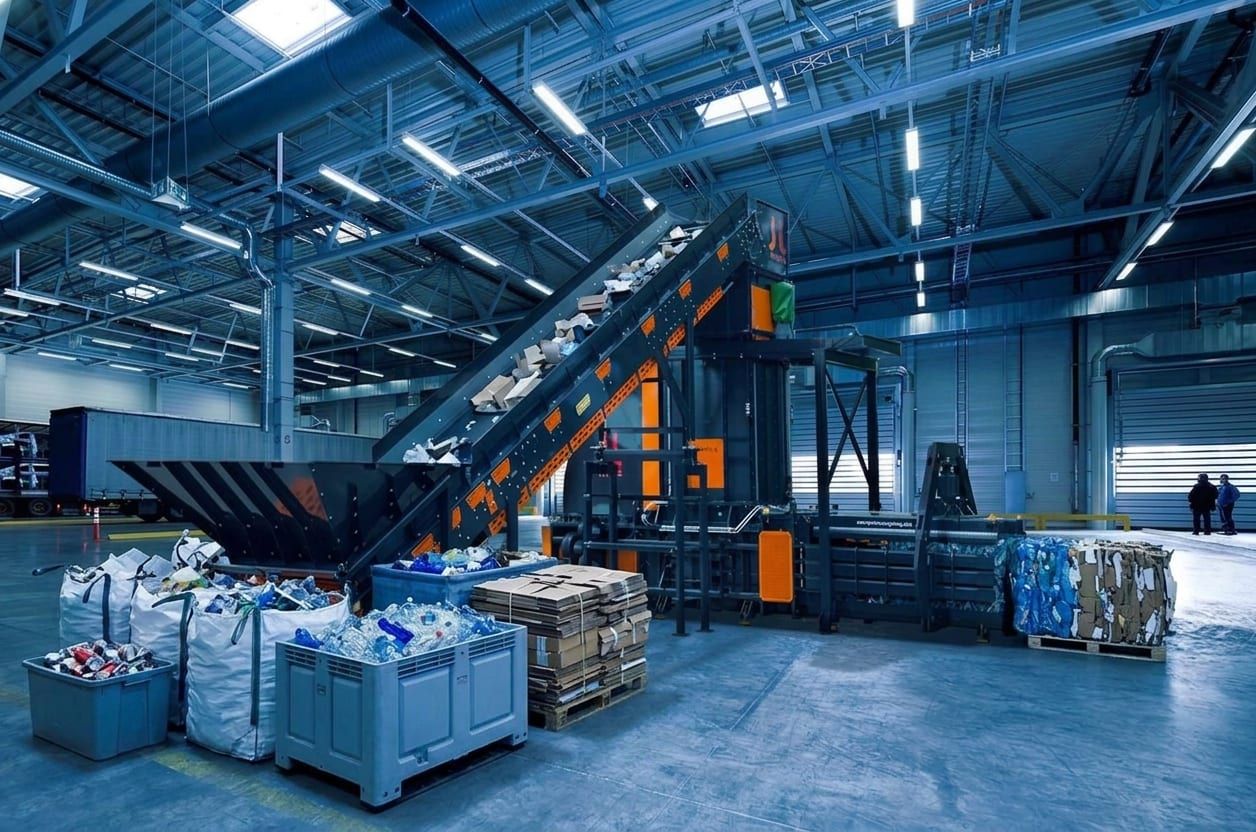
On-site waste management and segregation
On-site waste management means working where the waste is produced: separating cardboard, plastic film, wood, metal and plastics before they end up in the general waste container, and keeping the segregation points in order. We segregate waste on the client’s site. The client’s plant remains the waste holder. One of our waste operatives can also work at the plant — an additional service, partly funded by the savings that better segregation brings.
At a glance
- We segregate waste on the client’s site.
- The client’s plant remains the waste holder.
- One of our waste operatives can work at the plant. This is an additional service, partly funded by the savings that better segregation brings.
- We segregate every waste stream the plant produces.
Who it is for
- Plants with a dozen or more general waste containers that want to know how much of it could be recovered.
- Production plants where cardboard, film and pallets currently go into the general waste container.
- Logistics centres and warehouses with co-packing, order picking and repacking of goods.
- ESG and environmental teams that need data on waste stream volumes.
A waste operative on your site
Where waste is produced in many places at once, written instructions and labelled bins alone will not keep segregation going: streams get mixed, and the cardboard bins stand full next to an empty general waste container. That is when you need someone who looks after the whole flow on site every day.
Every general waste container you no longer fill means a lower invoice, and cardboard, film and metal separated in clean form cost less to have taken away — or the plant sells them as a raw material.
Formally, the plant remains the waste holder: it chooses the waste contractor and is responsible for the waste records. We organise collection — we tell the waste contractor when the containers are ready — and our operative on site handles everything that happens to the waste before it leaves the plant.
- Our operative looks after the segregation points by the lines, packing areas and loading bays, moves the segregated streams to bulk containers on site and makes sure that cardboard, film and metal do not end up in the general waste container.
What it costs to put everything in one container
For a plant, general waste is pure cost: you pay for every tonne and every time a container is emptied. Split into streams, the same waste is priced differently — baled cardboard, clean film and metal have value as secondary raw materials, and waste contractors charge for them differently from mixed waste.
The difference between the cost of a tonne of general waste and the price of a tonne of recyclables, multiplied by the annual volume, shows how much the plant is leaving in the container today. Our waste calculator gives current rates, with their date and source, and worked examples.
Most packaging waste is produced where goods are repacked: in co-packing, order picking and moving products from large bulk packaging into unit packs. That is where segregation pays off fastest.
Which waste streams a plant can separate
The value of a waste stream depends on how clean and uniform it is. Cardboard mixed with film and food scraps is worth little; the same cardboard, dry and pressed into bales, is a commodity.
- Hazardous waste — oily rags, empty chemical containers, fluorescent tubes — needs separate containers and procedures; it is classified by the waste holder.
| Waste stream | Where it is produced | What increases its value |
|---|---|---|
| Cardboard | Goods-in, order picking, co-packing | Dry, clean, pressed into bales |
| Stretch wrap and PE film | Breaking down pallets, wrapping loads | Free of tape, labels and cardboard scraps; baled |
| Pallets and wood | Goods-in, damaged pallets | Intact pallets kept apart from broken ones — some go back into use |
| Metals | Machining, maintenance, metal packaging | Steel kept apart from aluminium and other non-ferrous metals |
| Rigid plastics (PET, PP, HDPE) | Packaging, waste from injection moulding machines | One type of plastic per container |
| General waste | Everything that cannot be separated | The less there is, the lower the bill |
Who is responsible for what
Segregating waste on site does not change who the waste holder is. Your plant remains the waste holder; collection is carried out by a waste contractor registered in BDO (Poland’s national waste database) and chosen by the plant, and SARA SYSTEM organises it — we notify the contractor when the containers are ready for collection. Waste records, waste transfer notes (KPO in BDO) and BDO reporting stay with the plant.
| Task | Who is responsible |
|---|---|
| Separating waste into streams on site | SARA SYSTEM |
| Choosing the waste contractor and signing the contract with it | The plant — the waste holder |
| Organising collection (notifying when the containers are ready) | SARA SYSTEM |
| BDO records, waste transfer notes, reporting | The plant — the waste holder |
| Collection and onward treatment | The BDO-registered waste contractor chosen by the plant |
What mobilisation looks like
- Review of waste streams: how many containers there are, which streams end up in them, where the waste is produced and what collection costs today.
- Plan of segregation points: locations by the lines, packing areas and loading bays, bin labelling, space for bulk containers or a baler.
- Staffing decision: instructions and labelling, or a dedicated person on site — depending on how many points of waste generation the plant has.
- Instructions for plant staff — short, picture-based, at every point.
- Go-live and adjustments in the first weeks, once it is clear which streams are contaminated.
- A monthly summary of stream volumes, which the plant compares with its invoices.
- We set up segregation points by the lines and packing areas, label the bins, train plant staff and move the segregated streams to bulk containers on site.
- The cardboard and film balers belong to the plant — our operative can run them.
- Every month the plant receives a summary of how many containers of each stream we have prepared — data to compare with collection invoices and to use in ESG reporting.
Checklist: what to ask a contractor
Questions worth asking any cleaning company before you sign a contract, whoever you choose.
- Who is the waste holder after mobilisation — and does the contract say so explicitly?
- Is the company that will collect the waste registered in BDO for the right scope?
- Which waste streams does the contractor propose to separate, and based on what data about your containers?
- With your number of containers, do you need someone on site, or are instructions and labelling enough?
- Who operates the baler and the bulk containers?
- Will you receive a monthly summary of stream volumes to compare with your invoices?
Does SARA SYSTEM organise waste collection from the plant?
Yes — we organise collection. We segregate waste on the client’s site and notify the waste contractor when the containers are ready for collection. Your plant remains the waste holder, and the collection itself is carried out by a BDO-registered waste contractor chosen by the plant.
When is it worth having a waste operative on site?
When waste is produced in many places at once and instructions and labelling alone do not keep segregation going. We assess this during the site survey. For us it is an additional service, partly funded by the savings that better segregation brings.
Do we have to change the company that collects our waste?
No. On-site segregation works with your current waste contractor — the only change is how many streams it receives separately. Waste contractors usually have separate rates for cardboard, film and metal, lower than for general waste.
How much can a plant save through segregation?
It depends on the number of containers, the share of cardboard, film and metal, and the rates the plant currently pays for general waste. Our waste calculator works out the difference using your figures and gives recyclables prices with their date and source.
Who keeps the waste records in BDO?
The waste holder, which is the plant. Waste transfer notes (KPO) and BDO reporting stay with the plant; our operative working on its site does not change that.
Does segregation need extra space at the plant?
Usually less than you might think: baled cardboard and film take up a fraction of the volume of loose waste. You need labelled segregation points where the waste is produced and space for bulk containers or a baler.
Where does SARA SYSTEM operate?
We serve plants and warehouses in the Greater Poland, Lubusz and Lower Silesian voivodeships.
Often ordered together
Integrated cleaning services
Contract cleaning of plants and logistics centres: buildings, offices, grounds, consumables. Two contract managers per client, 92% of revenue from long-term contracts.
Details Contract cleaningFactory cleaning
Factory cleaning around your shifts and shutdowns: floors, walkways, workstations, staff areas. Greater Poland, Lubusz, Lower Silesia. Questions to ask a contractor.
Details Contract cleaningWarehouse cleaning
Warehouse cleaning without stopping dispatch: forklift tyre marks, dust on high-bay racking, loading bays. 470,500 m² of floor space under ongoing contracts.
Details Contract cleaningWashroom consumables and chemicals
Washroom consumables in three quality tiers and BUZIL chemicals from our own warehouse, delivered to site and invoiced by usage — for plants and warehouses.
DetailsIndustries
Automotive
Factory cleaning, press and paint line cleaning and floor deep cleaning in automotive plants, around production, shutdowns and IATF 16949 audits.
Logistics and warehousing
Warehouse cleaning, removal of forklift tyre marks, cardboard and film segregation, and snow clearance of access roads at logistics centres and warehouses.
Ask AI about your site
The AI assistant will read this page and the calculator, ask you about the scope you need (“On-site waste management and segregation”) and then, one question at a time, about your site — floor area, floor type, shifts, waste and site requirements. Finally, it will prepare a ready-to-send request for quotation with a list of open points.
- ChatGPT opens with a ready-made prompt (new tab)
- Claude opens with a ready-made prompt (new tab)
- Perplexity opens with a ready-made prompt (new tab)
Show the prompt
Help me prepare a request for quotation for industrial cleaning — topic: On-site waste management and segregation.

First open and read these pages of the contractor SARA SYSTEM. Open them directly; do not rely on search results alone:
- https://www.sarasystem.pl/en/services/on-site-waste-management/
- https://www.sarasystem.pl/en/cost-calculator/
- https://www.sarasystem.pl/llms.txt

Then interview me briefly about my site. Ask one question at a time, in English, and wait for my answer. Start by asking what exactly I need in terms of “On-site waste management and segregation”, then ask about the type of site and its floor area. Then ask in turn about:
1. the type of site and its floor area,
2. the floor type: bare, power-floated, sealed, painted or resin-coated concrete,
3. the soiling: tyre marks, oil, dust, old coatings,
4. the height of the building and the racking,
5. the number of shifts and whether the site keeps operating while the work is done,
6. how often the work is needed,
7. the scope: machine cleaning, high-level surfaces, washrooms, loading bays,
8. waste,
9. health and safety requirements, public liability insurance and site standards,
10. who provides the machines and chemicals,
11. the start date.
If I don't know something, record it as an open question.

About SARA SYSTEM, write only what is on these pages — do not add anything. Whatever the pages do not say, add to the questions for the contractor. If the calculator gives indicative costs, quote them as an estimate together with its assumptions.

Finally, write a ready-to-send email with the request to SARA SYSTEM (biuro@sarasystem.pl): the site parameters as bullet points and a list of open questions.
The conversation takes place in the tool you choose — we have no access to it. The assistant can make mistakes, so it is worth confirming the details with us directly.
A site survey as early as the same or the next day
We will come and look at your floors and zones, then prepare a work plan with a quote.