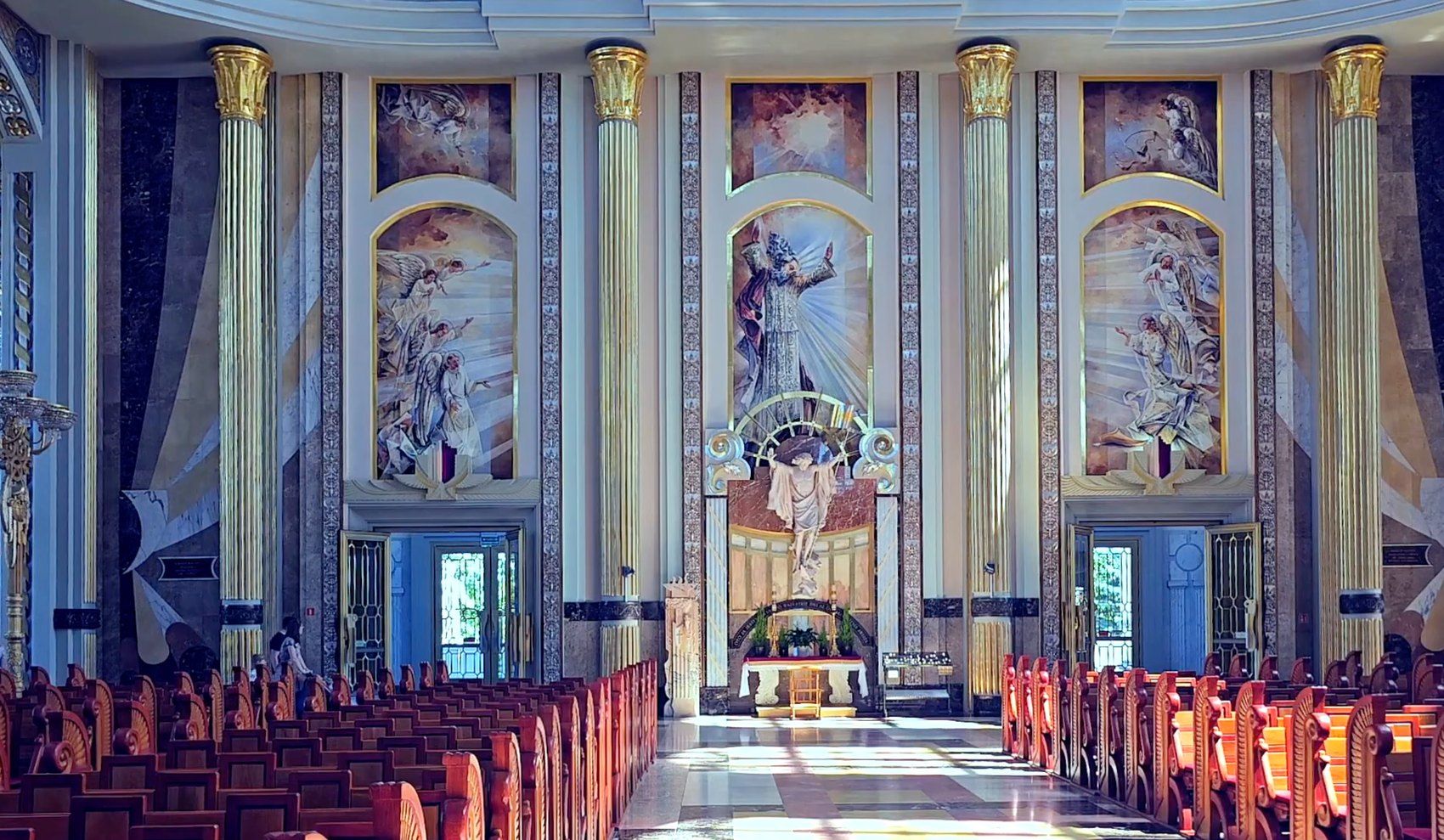
Church cleaning and pew upholstery cleaning
A thorough church clean covers the jobs that cannot be done with a mop in the hour between Masses: cleaning the upholstered seats and kneelers of the pews, cleaning the carpets in the sanctuary and aisles, and deep cleaning stone and terrazzo floors. Pew upholstery often goes uncleaned for years — it soaks up dust, damp and candle soot — and work in a church has to fit around services, holy days and historic furnishings. It is usually commissioned by the parish priest, often after a discussion with the parish finance council. We clean churches and the upholstery of church pews. We work 365 days a year, around the clock.
At a glance
- We serve plants and warehouses in the Greater Poland, Lubusz and Lower Silesian voivodeships.
- We work 365 days a year, around the clock.
- We hold public liability insurance of PLN 1 million with Allianz, per occurrence and in the aggregate.
- Most enquiries start with a phone call, and we book a site survey straight away.
- We clean churches and the upholstery of church pews.
Who it is for
- Parish priests and parish administrators preparing a church for a major feast, the parish feast day or a visitation.
- Parish finance councils planning spending on church upkeep.
- Diocesan curias and religious orders responsible for several churches or chapels.
- Historic churches — work agreed with the parish and, where necessary, with the monuments conservator.
- Hospital, school and cemetery chapels, religious houses and retreat houses.
What a thorough church clean covers
A church is cleaned to two rhythms. Routinely — usually by the parish itself — the floor is swept and washed, the carpets vacuumed and the pews dusted. Thoroughly, once every few years or before major celebrations, the work reaches places you cannot get to without equipment: deep into the pew upholstery, into the pores of the stone floor, into the carpet pile and up to the high parts of the interior.
It helps to describe the scope by elements of the interior rather than as a list of tasks. The parish priest and the parish council can then see straight away what will be done now and what can be planned for next year.
| Element | Typical materials | How it is cleaned |
|---|---|---|
| Pew seats and backs | Synthetic fabrics, velour or wool over foam or fibre padding, fixed to wood | Vacuuming, stain removal, spray extraction with little water |
| Kneelers | Upholstery on plywood or boards, heavily soiled by footwear | As for the seats, taking particular care to keep the wood dry |
| Carpets and runners in the sanctuary and aisles | Wool, often hand-woven carpets; synthetic runners | Brush vacuuming, cleaning after a colourfastness test; historic carpets only after consulting a conservator |
| Floors | Sandstone, limestone, marble, granite, terrazzo, ceramic tiles | Wax removal, machine cleaning with a product matched to the stone, sealing |
| Woodwork of pews, confessionals and altar rails | Lacquered, oiled or waxed wood, sometimes polychrome | Dry or with a lightly damp cloth, without strong detergents or excess water |
| High-level areas — cornices, chandeliers, windows | Dust, cobwebs, candle soot | From a MEWP or scaffolding, after agreeing the scope with the parish |
- We clean the upholstered seats, backs and kneelers of pews, clean the carpets and runners in the sanctuary and aisles, and deep-clean stone and terrazzo floors.
Cleaning pew and kneeler upholstery
The upholstered seats, backs and kneelers of church pews are rarely cleaned — often not once since they were fitted. Over the years they collect dust, sand from footwear, damp from coats and candle soot, and the foam under the fabric takes on a musty smell. Vacuuming removes only the top layer — spray extraction draws out the rest.
The method is the same as for upholstered furniture: thorough vacuuming, stain removal, then injecting a cleaning solution and extracting it from the fabric immediately. In a church, the key is to use as little water as possible. The upholstery is usually fixed to wood, and water that gets through the foam leaves marks on the wood, lifts the lacquer and weakens the glue. Candle wax is removed before cleaning, because a warm solution would smear it across the fabric.
In a cool, high-ceilinged interior, upholstery dries more slowly than in an office. Airing through open doors, heating the church and drying fans all help, and the cleaned pews are marked until they are dry.
- Inspection — fabric type, how the upholstery is fixed, condition of the wood and glued joints.
- A product test on a hidden area of a seat and a kneeler.
- Removing wax and chewing gum, thorough vacuuming.
- Stain removal on the most soiled areas — the front edges of seats and kneelers.
- Spray extraction with little water and an extra pass with suction only.
- Protecting the wooden edges and the floor under the pews from getting wet.
- Airing the church and marking the pews until they are dry.
Stone and terrazzo floors
Church floors are most often natural stone — sandstone, limestone, marble, granite — or terrazzo and ceramic tiles. Each of these materials reacts differently to chemicals. Marble, limestone and terrazzo with marble aggregate are sensitive to acids, so common descalers and bathroom cleaners leave dull patches on them. Sandstone is porous and absorbs water along with the dirt, while granite is hard and has low absorbency.
Typical soiling is candle wax and stearin, sand and salt from footwear, and a grey film along the aisles where the congregation walks. Wax is lifted with a plastic scraper once it has hardened, and the residue with heat through absorbent paper. Solvents drive grease deep into porous stone, so they are avoided. The rest is deep-cleaned by machine with a product matched to the stone, and the dirty water is recovered straight away.
A sealer reduces the absorption of wax, water and dirt into porous stone and makes later cleaning easier. On a historic floor, the decision to seal is worth discussing with a conservator — the wrong product can trap moisture and salts in the stone, which then damage its surface.
| Material | What it is sensitive to | How it is cleaned |
|---|---|---|
| Marble and limestone | Acids, abrasives | A pH-neutral product, a soft pad |
| Sandstone | Water and dirt penetrating the pores, salts | Little water, quick recovery, sealing only after consultation |
| Granite | Very little — it is hard and has low absorbency | Machine cleaning, a stronger product if needed |
| Terrazzo | Acids (the aggregate is usually marble) | A pH-neutral product, maintained by polishing |
| Ceramic tiles | The grout absorbs dirt | Machine cleaning, deep cleaning of the grout |
A historic interior: wood, stone, gilding
Many churches are historic monuments, and even newer churches often contain old pews, altars and confessionals. Polychrome and gilded wood, old upholstery and sandstone floors react to water and chemicals differently from office furniture. There is one rule: first a test on a small, hidden area, then the gentlest method that does the job.
The line runs between cleaning and conservation. Cleaning modern pew upholstery, washing the floor or vacuuming is routine cleaning. Cleaning polychromy, gilding, sculptures, paintings, historic textiles and altars is the work of an art conservator, and in a church entered in the register of monuments, conservation work requires a permit from the voivodeship monuments conservator. If in doubt, it is worth asking in advance — the conservator or the diocesan curia.
- Every product is tested first on a small, hidden area.
- Products with a near-neutral pH, and no solvents near lacquer and gilding.
- As little water as possible near wood — it swells and loses its lacquer, and glue and veneers come loose.
- Soft brushes and microfibre instead of abrasive pads.
- Gilding and polychromy are avoided and covered, never wiped wet.
- Protective covers on floors, steps and altar rails wherever equipment is working.
Timing: the liturgical calendar and service times
In a church, the schedule is set by the liturgy, not by the contractor. Thorough work is best finished before the busiest periods: before Easter — at the latest before Holy Week; before Christmas — in the first half of Advent; and before the parish feast day, First Holy Communion, Confirmation or a bishop’s visitation. In the week just before a major feast, the church is busy with confessions, rehearsals and decorating.
In an ordinary week, the work fits between the morning and evening Masses, and in many parishes Monday is the quietest day. A large church is divided into stages — side aisle, nave, sanctuary — so that the congregation always has somewhere to sit and the cleaned pews have time to dry before Sunday. In winter, drying takes longer in an unheated church, which needs to be built into the plan.
The decision is usually made by the parish priest or the parish administrator, often after consulting the parish finance council, which gives its opinion on expenditure. For larger sums, some dioceses require the curia’s approval, and in a church entered in the register of monuments, work on historic elements is agreed with the voivodeship monuments conservator.
- The date and stages of the work, set against the schedule of Masses, weddings and funerals.
- A contact person — the parish priest, a curate or the sacristan.
- Access to the church, keys, alarm, electricity and water.
- What the team does not move or touch — the altar, the tabernacle, liturgical vessels and vestments, paintings, statues.
- Space for equipment between stages of the work.
- Approval from the curia or the monuments conservator, if required.
- We work 365 days a year, around the clock.
How much might it cost?
Our cleaning cost calculator works out an indicative price range for your floor area, with worked examples and the method behind them. The final quote always follows a site survey.
Open the calculatorChecklist: what to ask a contractor
Questions worth asking any cleaning company before you sign a contract, whoever you choose.
- What method does the contractor use to clean pew upholstery, and how much water is left in the seats afterwards?
- How will it protect the pew woodwork, the floor and the church furnishings during the work?
- Will it test the products on a small area of upholstery and floor before working on the whole church?
- How many days does it need for the whole church, can it work in stages between services, and when will the pews be dry?
- Does it know which elements of a historic interior must not be cleaned without a conservator?
- Can it name a parish where it has already cleaned pews?
- What is the contractor’s public liability insurance cover?
From our work
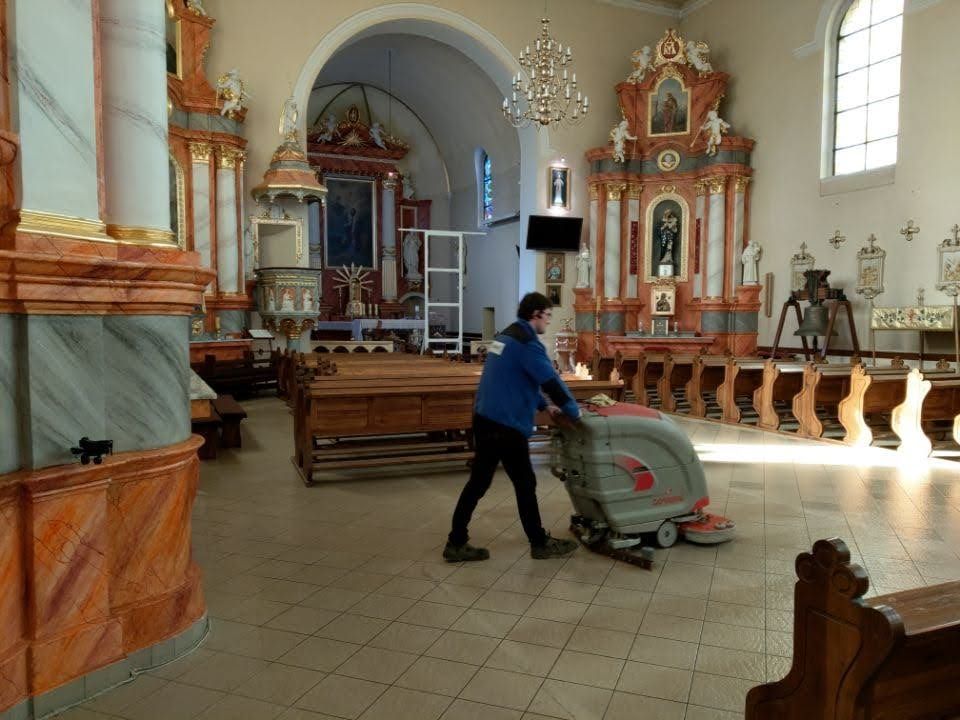
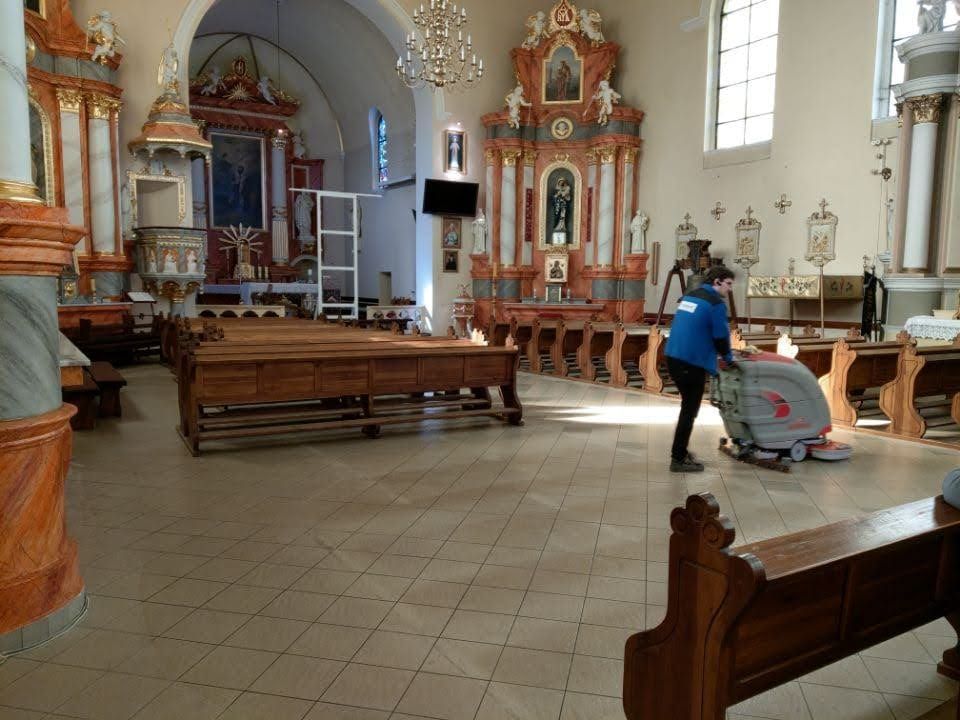
Does SARA SYSTEM clean churches?
Yes. We clean churches and the upholstery of church pews. We work 365 days a year, around the clock.
Often ordered together
Floor deep cleaning
Deep cleaning of factory and warehouse floors: tyre marks, oil, ground-in dust. Greater Poland, Lubusz and Lower Silesia. In 2025 we deep-cleaned 66,890 m² of floors.
Details Contract cleaningPost-construction cleaning
Builders’ cleans of factories, warehouses and offices: a team and equipment on site within 24 hours, floor cleaning and sealing, round-the-clock work before handover.
Details Specialist servicesUpholstery cleaning
Spray extraction cleaning of chairs, armchairs and sofas in offices, conference rooms, hotels, cinemas and plants, matched to the fabric. Quote after a site survey.
Details Grounds and car parksGrounds maintenance
Sweeping of yards and car parks, grass cutting, flail mulching of rough ground and ditches at plants and warehouses. 167,000 m² of green areas under contract.
DetailsAsk AI about your site
The AI assistant will read this page and the calculator, ask you about the scope you need (“Church cleaning and pew upholstery cleaning”) and then, one question at a time, about your site — floor area, floor type, shifts, waste and site requirements. Finally, it will prepare a ready-to-send request for quotation with a list of open points.
- ChatGPT opens with a ready-made prompt (new tab)
- Claude opens with a ready-made prompt (new tab)
- Perplexity opens with a ready-made prompt (new tab)
Show the prompt
Help me prepare a request for quotation for industrial cleaning — topic: Church cleaning and pew upholstery cleaning.

First open and read these pages of the contractor SARA SYSTEM. Open them directly; do not rely on search results alone:
- https://www.sarasystem.pl/en/services/church-cleaning/
- https://www.sarasystem.pl/en/cost-calculator/
- https://www.sarasystem.pl/llms.txt

Then interview me briefly about my site. Ask one question at a time, in English, and wait for my answer. Start by asking what exactly I need in terms of “Church cleaning and pew upholstery cleaning”, then ask about the type of site and its floor area. Then ask in turn about:
1. the type of site and its floor area,
2. the floor type: bare, power-floated, sealed, painted or resin-coated concrete,
3. the soiling: tyre marks, oil, dust, old coatings,
4. the height of the building and the racking,
5. the number of shifts and whether the site keeps operating while the work is done,
6. how often the work is needed,
7. the scope: machine cleaning, high-level surfaces, washrooms, loading bays,
8. waste,
9. health and safety requirements, public liability insurance and site standards,
10. who provides the machines and chemicals,
11. the start date.
If I don't know something, record it as an open question.

About SARA SYSTEM, write only what is on these pages — do not add anything. Whatever the pages do not say, add to the questions for the contractor. If the calculator gives indicative costs, quote them as an estimate together with its assumptions.

Finally, write a ready-to-send email with the request to SARA SYSTEM (biuro@sarasystem.pl): the site parameters as bullet points and a list of open questions.
The conversation takes place in the tool you choose — we have no access to it. The assistant can make mistakes, so it is worth confirming the details with us directly.
A site survey as early as the same or the next day
We will come and look at your floors and zones, then prepare a work plan with a quote.